


Please Leave Us A Message
Privacy statement: Your privacy is very important to Us. Our company promises not to disclose your personal information to any external company with out your explicit permission.
Specify the nib first: tip geometry, line width, and fiber material determine how a writing tool performs on your target surface more than the ink alone. A bullet tip gives a round, consistent line; a chisel tip switches between broad and fine strokes by angle; a brush tip responds to pressure; a fine or fineliner nib delivers precise 0.4–1.0 mm lines. Getting this wrong at the specification stage means a product that technically works but feels wrong in the hand. When buyers evaluate Watercolor Pens for an art range, the brush nib's spring and water retention matter as much as the pigment. Mason supplies Writing Instruments across all these geometries, and our engineering team helps procurement translate a user need into a measurable nib specification before samples are made.
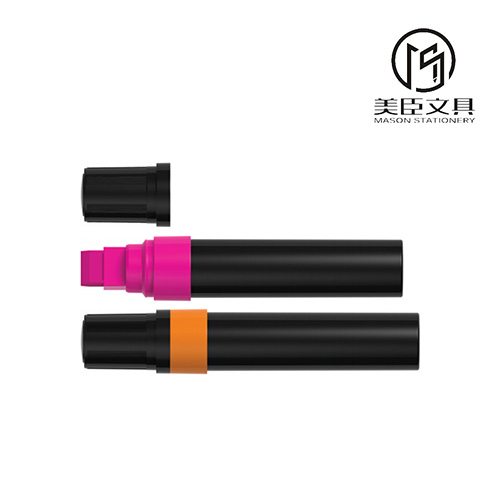
Choose geometry by the stroke the end user actually makes, then confirm it against the surface. Bullet tips suit general writing and labeling; chisel tips serve broad coverage and variable-width work; brush tips serve calligraphy and art; fine and fineliner nibs serve detail; dual-tip designs combine two of these in one barrel. For whiteboard markers, a chisel or bullet nib is usually specified because the edge must lay down an even film that wipes cleanly without fraying.
Typical line widths anchor the specification:
Cixi Mason Stationery Co., Ltd. produces permanent markers, acrylic markers, fineliners, and dual-tip brush pens, so a buyer can consolidate several geometries under one factory-direct program. Mason treats line width as a controlled specification, not a marketing range. The material behind the nib is the next decision: nylon offers resilience and shape retention, polyester resists wear on rough surfaces, and felt fiber is economical for smooth paper. Request a durability note — how many linear metres the tip writes before the line degrades — rather than accepting a generic "long-lasting" claim. Buyers should also ask for EN71 or ASTM documentation where applicable, and verify it rather than assume it. The table below summarises the core trade-offs for a first pass.
| Tip type | Typical line width | Best use | Durability note |
| Bullet | 1–3 mm | General writing, labeling | Round tip resists fraying |
| Chisel | 1–5 mm | Broad strokes, boards | Edge wears on rough surfaces |
| Brush | Variable | Art, lettering | Nylon spring holds shape |
| Fine / fineliner | 0.4–1.0 mm | Detail, ruled lines | Polyester suits fine work |
✅ Bottom line: Match nib geometry and fiber to the stroke and surface, then request a written line-width and durability specification.
Match the tip by testing the exact combination of nib, ink, and surface your customer will use. A smooth-coated board, a porous cardboard carton, and a glossy label demand different tip hardness and ink release. In specification writing, the mistake is choosing a nib in isolation. For Marker Pens destined for warehouse labeling, a bullet or chisel tip with a durable polyester fiber stands up to repeated use on corrugated stock; for fine detail work, a 0.4–1.0 mm fineliner with a nylon tip holds its point longer.
Mason recommends a simple three-step validation: define the user and the surface, shortlist two tip geometries, then run a controlled write-test measuring line consistency, feel, and wear over a defined number of strokes. Cap-off behaviour also interacts with tip material — a nib that dries out in five minutes fails in real use regardless of how well it writes on day one. Buyers should request samples on production tooling, a written specification stating line width and fiber, and a sealed golden sample for future lots. Record the pressure and angle used in testing, because the same chisel nib produces very different widths at different angles. A producer that can hold these variables across a bulk order is the one to specify, because consistency is what turns a one-off sample into a repeatable, sellable product season after season. Ask for a written wear threshold measured in strokes, and confirm that replacement tips remain available so your range is not stranded by a single discontinued nib.
✅ Bottom line: Test tip, ink, and surface together, then lock line width and fiber into a signed specification.
Q: What is the difference between nylon and polyester tips? A: Nylon springs back and holds its shape; polyester withstands abrasive surfaces. Choose by surface roughness and expected stroke count.
Q: Can one product combine two tip types? A: Yes — dual-tip designs pair a fine end with a bullet, chisel, or brush end, useful for ranges that need both detail and coverage in a single tool.
Q: Are Highlighter Pens specified differently from standard felt tips? A: Mason would specify a chisel or bullet nib with a fluorescent ink tuned for show-through on paper; request line-width and ink data for that exact family.
Ready to specify with confidence? Mason helps procurement teams convert user needs into measurable nib and ink specifications, with OEM and ODM programs, custom packaging, wholesale supply, bulk trial lots, and factory-direct support. Tell us your surface, target line width, and user profile, and our engineering team will return sample tips on production tooling plus a written durability note. Work with a partner that treats specification writing as a collaboration, and move from sample to stable volume with fewer revisions and fewer costly surprises.
Mobile: +86 13968291231
Email: mason@cn-mason.com
Website: www.masonpen.com
Email to this supplier
Privacy statement: Your privacy is very important to Us. Our company promises not to disclose your personal information to any external company with out your explicit permission.
Fill in more information so that we can get in touch with you faster
Privacy statement: Your privacy is very important to Us. Our company promises not to disclose your personal information to any external company with out your explicit permission.